
- Home
- Compare the arts
- Jeet Kune Do vs Wing Chun
Compare the arts
Jeet Kune Do vs Wing Chun
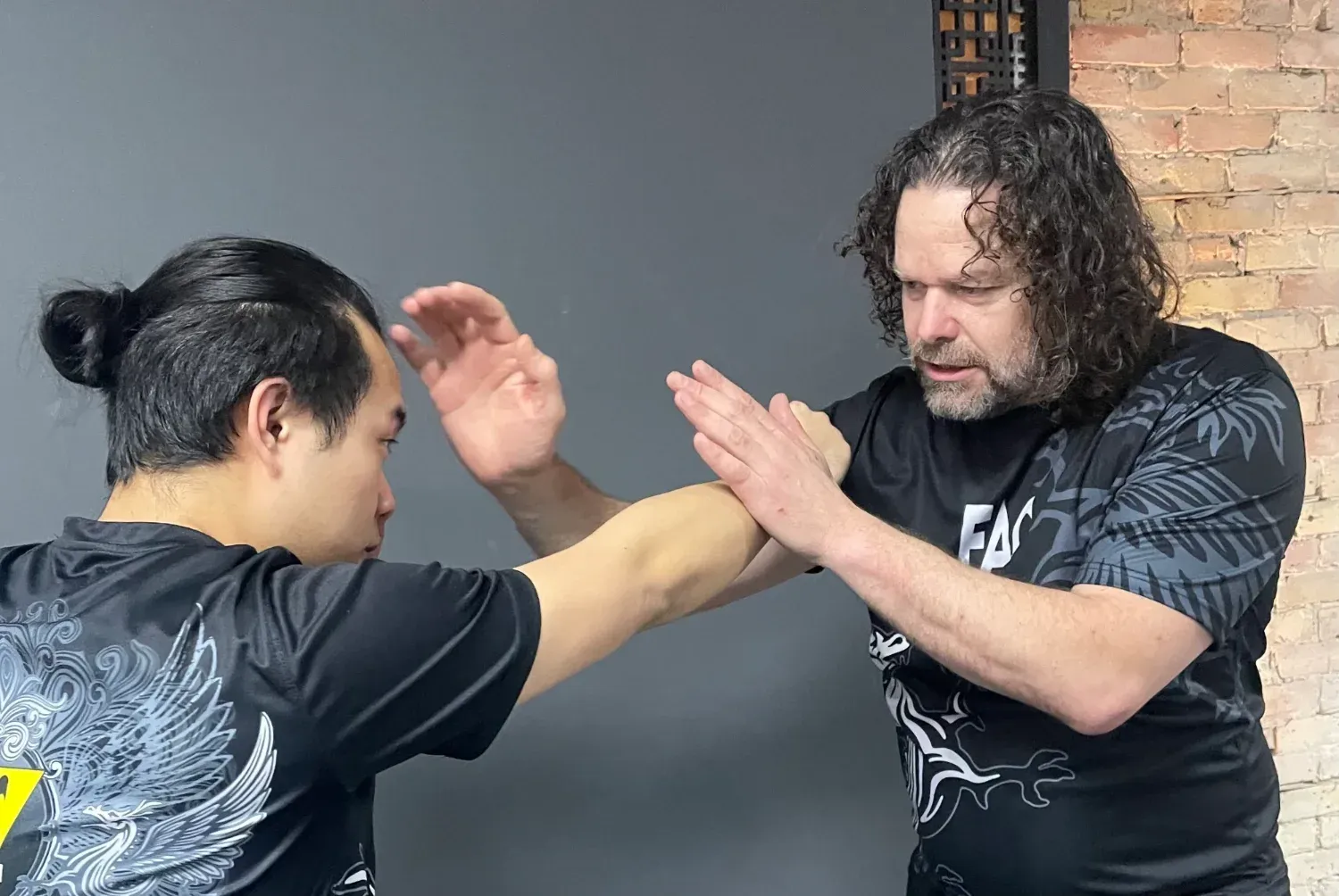
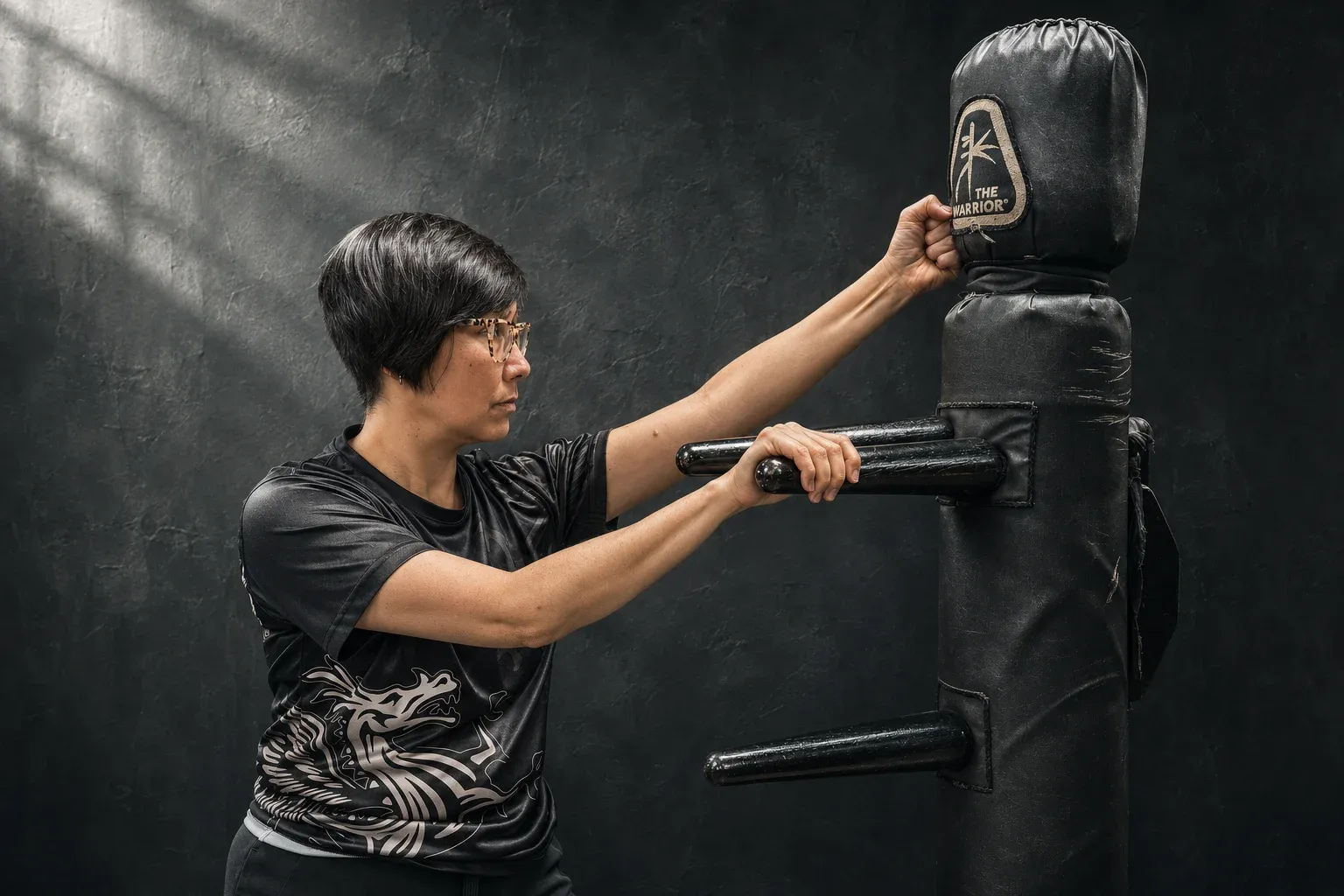
Wing Chun is the parent and Jeet Kune Do is the child. Wing Chun is a traditional Chinese system that fights at close range, square to the opponent, controlling the centreline through touch. Jeet Kune Do is the art Bruce Lee built on his Wing Chun: it keeps the centreline and the trapping, adds boxing footwork and fencing timing, and prefers to intercept from further out.
Side by side
| Jeet Kune Do | Wing Chun | |
|---|---|---|
| Origin | Founded by Bruce Lee in 1967 | Southern China, taught openly by Ip Man from 1950 |
| Preferred range | Long to middle: the fighting measure | Close: arm’s length and inside |
| Stance | Side-on, strong side forward, light on the feet | Square to the opponent, rooted |
| Core tactic | Intercept the attack as it begins | Hold the centreline, strike along it |
| Signature tool | The straight lead and the stop-kick | The chain punch and chi sau |
| Footwork | Mobile: step and slide, push shuffle, borrowed from boxing and fencing | Compact: short steps and turning |
| How it is taught | Drills, pads and decision-making. No forms | Three hand forms, wooden dummy, chi sau, two weapons |
| Suits you if | You want direct, practical striking and like to know why | You want close-range precision and a clear traditional path |
What they share
Both arts defend and attack along the centreline. Both prefer straight lines to wide ones, and both strike and defend in the same motion instead of blocking first. Jeet Kune Do’s trapping, the hand immobilisation attack, is Wing Chun’s chi sau put to work. If you learn one, the other will feel familiar.
Where they part
Bruce Lee came to believe that staying close and square left him too little room against a mobile opponent. He turned side-on like a fencer, put his strong hand forward, and used footwork to control distance. Wing Chun stays where it is strongest: inside, where structure and sensitivity beat reach and speed.
Which should you choose?
If the idea of footwork, timing and hitting first excites you, start with Jeet Kune Do. If you are drawn to precise, close work and a system with a clear order to it, start with Wing Chun. At Fighting Arts Collective they are taught two nights apart in the same building, so many students end up training both.
Try them
Both are taught here.
Your first class is free. Take it in the one that sounds like you.
Straight answers
Common questions
Is Jeet Kune Do just Wing Chun?
No. Wing Chun is one of its three main sources, along with Western boxing and fencing. Jeet Kune Do kept Wing Chun’s centreline, straight punch and trapping, and changed the stance, footwork and range.
Did Bruce Lee study Wing Chun?
Yes. He trained under Ip Man in Hong Kong as a teenager, before moving to the United States in 1959.
Which is better for self-defence, JKD or Wing Chun?
Both are complete systems. Jeet Kune Do starts by managing distance and intercepting; Wing Chun starts by controlling close range. The better one is the one you will keep training.
Can I learn both at the same time?
Yes. At Fighting Arts Collective, Jeet Kune Do is on Tuesdays and Wing Chun on Thursdays, both at 846 College Street, and Premium memberships include both.